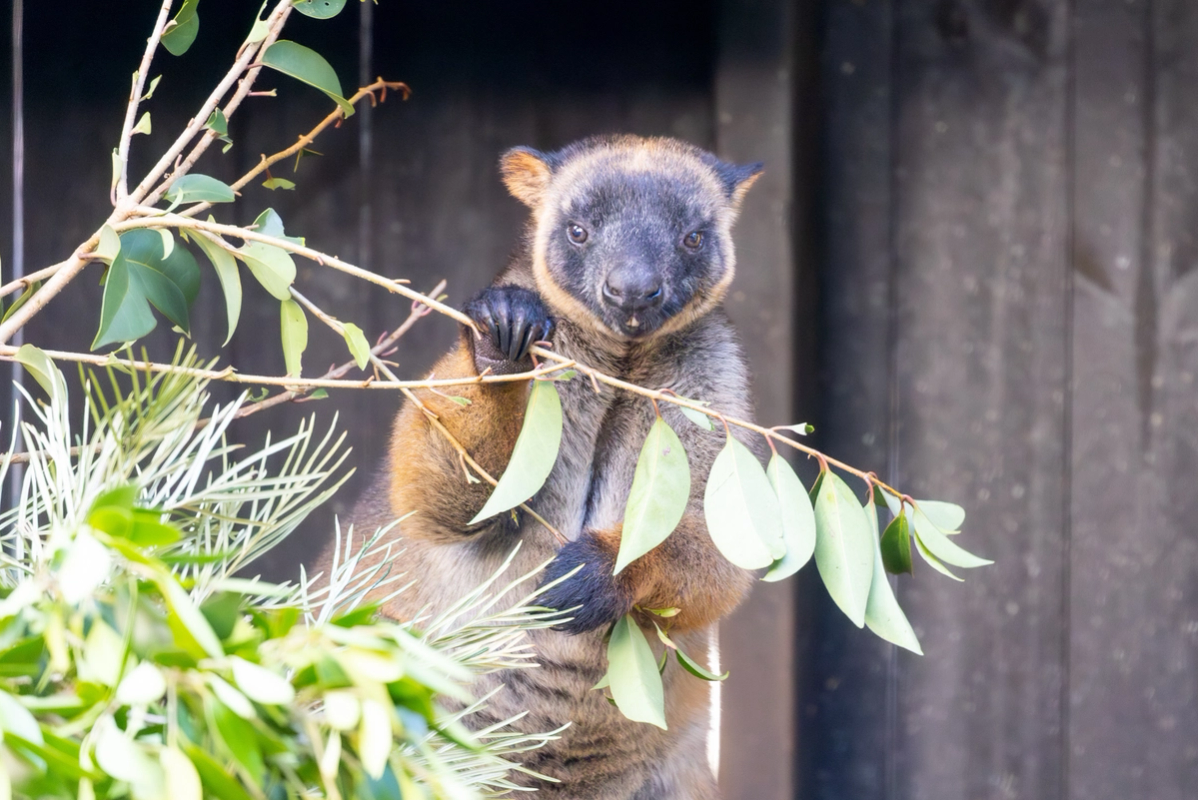
Quick Facts
- Scientific name: Dendrolagus lumholtzi
- Family: Macropodidae (kangaroos and wallabies)
- Where they live: Wet Tropics of north Queensland, Australia (Atherton Tablelands and surrounding rainforests)
- Size: Males up to about 70cm body length, females slightly smaller
- Weight: Males up to 8kg, females around 6kg
- Lifespan: Up to 15 years in captivity; shorter in the wild
Description
The Lumholtz Tree Kangaroo looks quite different from its ground-dwelling relatives. Its body is stocky and compact, with a dark brownish-black coat across the back and a pale, cream-coloured belly. A distinctive pale band crosses the forehead, giving the face a masked appearance that makes it immediately recognisable.
Where ground kangaroos have long, powerful hind legs built for bounding, the Lumholtz Tree Kangaroo has shorter, more equal-length limbs with strong, curved claws designed for gripping branches. Its hind feet are broad and padded with rough soles that provide grip on bark and wet branches. Its long, heavy tail, roughly the same length as its body, acts as a counterbalance while moving through the trees.
The Lumholtz Tree Kangaroo is the smaller of the two tree kangaroo species found in Australia, the other being Bennett's Tree Kangaroo. Despite their modest size, these animals are powerful climbers and can move with surprising speed through dense rainforest vegetation. On the ground they move awkwardly, but in the trees they are completely at home.
Habitat
Lumholtz Tree Kangaroos are found only in the Wet Tropics World Heritage Area of far north Queensland, particularly around the Atherton Tablelands and the surrounding highland rainforests. This makes them one of Australia's most geographically restricted mammals.
They prefer dense, upland rainforest with a continuous canopy, spending the vast majority of their time in the trees. During the day they rest on high branches, often curled into a comfortable position with their tail hanging down. At dawn and dusk they are most active, moving through the canopy in search of food.
Because they depend on intact rainforest, Lumholtz Tree Kangaroos are highly sensitive to habitat loss. Land clearing for agriculture, particularly on the Atherton Tablelands, has reduced and fragmented their range significantly over the past century. They are also vulnerable to predation by dogs, cats and cars, particularly in areas where farmland and rainforest patches meet.
Diet
Lumholtz Tree Kangaroos are herbivores with a diet focused on the leaves, shoots, ferns and flowers available in their rainforest habitat. Like koalas, they have evolved to digest tough, fibrous plant matter that other animals largely avoid.
Their diet includes a wide variety of rainforest plant species, with leaves making up the bulk of their food. They will also eat fruit, bark, sap and flowers when available, and their appetite for fig leaves and other soft foliage makes them important seed dispersers within the rainforest ecosystem.
Despite the relatively low nutritional value of leaves, the Lumholtz Tree Kangaroo is an efficient feeder. It has a slow metabolic rate and a specialised digestive system that allows it to extract as much energy as possible from its leafy diet, an adaptation it shares with other folivorous, or leaf-eating, animals.
Reproduction
Like all macropods, the Lumholtz Tree Kangaroo follows the classic marsupial reproductive pattern. After a short gestation of around 44 days, a tiny, underdeveloped joey is born and immediately crawls into the mother's forward-facing pouch, where it attaches to a teat and continues to develop.
The joey remains in the pouch for around nine to ten months, gradually growing and developing before it begins to venture outside. Even after leaving the pouch, young Lumholtz Tree Kangaroos stay close to their mothers for several more months, learning to climb and find food before becoming fully independent.
Females typically raise one joey at a time. Breeding can occur throughout the year, though it may be influenced by seasonal changes in food availability. Because they reproduce slowly and depend on specific rainforest habitat, Lumholtz Tree Kangaroo populations can take many years to recover from local decline, making conservation of their rainforest home especially critical.
Lumholtz Tree-Kangaroo FAQs
Is the Lumholtz Tree-Kangaroo found anywhere else in Australia?
No. The Lumholtz Tree Kangaroo is found only in the Wet Tropics of far north Queensland. It is one of Australia's most geographically restricted mammals, making it a very rare animal to encounter outside of zoos and wildlife parks.
Are Lumholtz Tree-Kangaroos endangered?
The Lumholtz Tree Kangaroo is currently listed as Least Concern on the IUCN Red List, but it faces ongoing threats from habitat loss, land clearing, feral predators and vehicle strikes. Conservation of the Wet Tropics rainforest is essential to protecting this species into the future.
How is a tree-kangaroo different from a regular kangaroo?
Unlike ground kangaroos, tree kangaroos have shorter, more equal-length limbs, stronger forearms, curved claws and broad, padded feet designed for gripping branches. Their long tail provides balance rather than propulsion. On the ground they are slow and awkward, but in the trees they are agile and confident climbers.
What do Lumholtz Tree-Kangaroos eat?
Lumholtz Tree Kangaroos are herbivores that eat rainforest leaves, shoots, ferns, flowers, fruit and bark. Leaves make up the bulk of their diet, and their digestive system is specially adapted to process tough, fibrous plant matter.
How big do Lumholtz Tree-Kangaroos get?
Males can grow to around 70cm in body length and weigh up to 8kg, while females are slightly smaller. They also have a long tail of similar length to the body that helps with balance in the trees.
Are Lumholtz Tree-Kangaroos nocturnal?
Lumholtz Tree Kangaroos are most active at dawn and dusk, which makes them crepuscular. During the day they typically rest high in the canopy, making them difficult to spot in the wild.
Can you see a Lumholtz Tree-Kangaroo in NSW?
Yes! Guests can see Lumholtz Tree Kangaroos at the Australian Reptile Park in Somersby on the Central Coast of NSW. This is a fantastic opportunity for families and wildlife lovers to get up close with a species that is rarely seen outside of far north Queensland.
Why is it called a Lumholtz Tree-Kangaroo?
The species is named after Carl Sofus Lumholtz, a Norwegian explorer and naturalist who first described the species for Western science during his travels in Queensland in the 1880s.
How do Lumholtz Tree-Kangaroos move through trees?
They use their strong forearms and curved claws to grip branches and pull themselves upward. Their broad, padded hind feet lock onto bark for stability, and their long heavy tail counterbalances their body as they move. They can also leap between branches and drop from significant heights to the ground when needed.
Do Lumholtz Tree-Kangaroos have pouches?
Yes. Like all marsupials, females have a forward-facing pouch where joeys develop after birth. The joey stays in the pouch for around nine to ten months before beginning to venture outside.