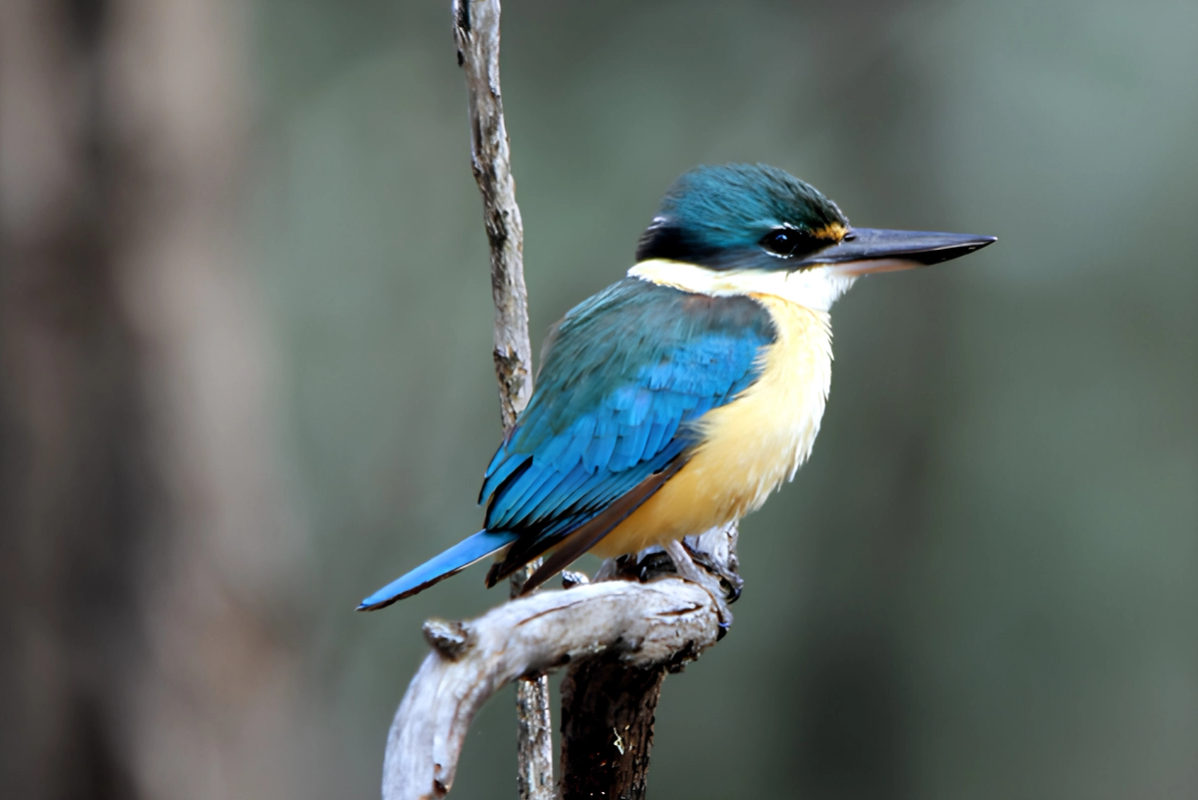
Sacred Kingfisher
Todiramphus sanctus
Conservation Status: Least Concern
Sacred Kingfisher
The Sacred Kingfisher is one of Australia's most beloved and widely recognised birds. Dressed in brilliant turquoise-blue, white and buff, with a bold black mask and a large, powerful bill, it is a bird that catches the eye even at a distance. It is also one of the most widespread kingfisher species in the country, found in habitats ranging from coastal mangroves and open woodlands to parks, gardens and farmland.
Contrary to what many people expect, the Sacred Kingfisher is not just a fish-eater. It is a highly skilled hunter that pursues a wide variety of prey including insects, lizards, frogs and small reptiles, diving from a perch with remarkable speed and accuracy.
Guests visiting the Australian Reptile Park on the Central Coast can see this stunning species up close. For families and nature lovers, the Sacred Kingfisher is a brilliant introduction to one of Australia's most charismatic and capable birds.
Quick Facts
- Scientific name: Todiramphus sanctus
- Family: Alcedinidae (kingfishers)
- Where they live: Throughout Australia, New Zealand, Southeast Asia and parts of the Pacific
- Size: Around 19 to 23cm long
- Weight: Around 25 to 45g
- Lifespan: Around 5 to 8 years
Description
The Sacred Kingfisher is a medium-sized kingfisher with a stocky body, short neck, large head and a long, heavy bill that tapers to a sharp point. The upperparts, including the back, wings and tail, are a rich turquoise to blue-green colour that can appear to shift in different light. The underparts are white to pale buff, and there is a white or pale collar around the back of the neck.
A broad black stripe runs from the base of the bill through the eye and down either side of the neck, giving the bird a masked appearance. The bill itself is dark, long and dagger-like, perfectly suited to seizing prey.
Males tend to be more vividly coloured than females, and juveniles have a duller, browner version of the adult pattern with fine scalloping on the breast. Despite these subtle differences, Sacred Kingfishers are straightforward to identify across all ages thanks to their distinctive shape and colouring.
Their call is one of the most recognisable sounds of the Australian bush: a loud, sharp, repeated "ki-ki-ki-ki" that carries clearly across open country. During the breeding season this call becomes more frequent and insistent as birds establish and defend territories.
Habitat
The Sacred Kingfisher is one of the most habitat-flexible kingfisher species in Australia. It is found in open forests and woodlands, coastal scrub, mangroves, farmland, parks, gardens and areas near rivers, wetlands and estuaries. This adaptability makes it one of the most commonly encountered kingfishers across the country.
In southern Australia, Sacred Kingfishers are migratory. They move north in autumn and return south in spring and summer to breed, following the availability of food and suitable nesting sites. In the north of the country and in New Zealand, some populations are resident year-round.
The bird is also found well beyond Australia, with its range extending through Southeast Asia, New Guinea and various Pacific islands. This wide distribution reflects how well it has adapted to different environments across the region.
Sacred Kingfishers are territorial and typically solitary outside of the breeding season. They favour habitats with open ground or clear water below prominent perch sites, which they use as hunting platforms.
Diet
Despite being called a kingfisher, the Sacred Kingfisher eats far more than fish. Its diet includes insects, beetles, grasshoppers, spiders, earthworms, crabs, small frogs, lizards, small snakes and occasionally small mammals. Fish are taken when available but make up a relatively small proportion of the diet compared to many other kingfisher species.
The Sacred Kingfisher is a perch hunter. It sits motionless on an exposed branch, fence post or wire, scanning the ground or water below with sharp eyes. When prey is spotted, it dives quickly and precisely, snatching the animal in its bill before returning to the perch. Prey is often beaten against the perch to stun or kill it before being swallowed headfirst.
This hunting style requires an open field of view beneath the perch, which is why Sacred Kingfishers are so often spotted sitting on fences, powerlines and bare branches at the edges of open areas.
Reproduction
Sacred Kingfishers nest in cavities rather than building an open nest. They excavate tunnels into the soft wood of termite mounds, earth banks, or use existing hollows in tree branches and trunks. Both parents take part in excavating the nesting chamber, which can take one to two weeks to complete.
The female lays a clutch of three to six round, white eggs directly onto the floor of the chamber with no nesting material. Both parents share incubation duties over a period of around 17 to 18 days. Once hatched, the chicks are fed by both parents and develop quickly, fledging at around 25 to 26 days old.
Pairs may raise more than one brood in a season if conditions are good. After the breeding season, family groups disperse and birds become solitary again until the following spring.
The name "sacred" is thought to come from the Maori people of New Zealand, who regarded the species as sacred and believed it had power over the sea.
Sacred Kingfisher FAQs
Why is it called the Sacred Kingfisher?
The name "sacred" is believed to come from the Maori people of New Zealand, who held the species in high regard and considered it to have power over the ocean. It is one of several cultural names the bird has collected across its wide range.
Do Sacred Kingfishers only eat fish?
No. Despite the name, Sacred Kingfishers eat a wide variety of prey including insects, lizards, frogs, spiders, earthworms, crabs and small reptiles. Fish are eaten when available but are not the main part of their diet.
Where do Sacred Kingfishers live in Australia?
Sacred Kingfishers are found throughout Australia in a wide range of habitats including open woodlands, mangroves, farmland, coastal scrub, parks and gardens. In southern Australia they are migratory, moving north in autumn and returning south to breed in spring and summer.
How do Sacred Kingfishers hunt?
Sacred Kingfishers are perch hunters. They sit on an exposed branch, post or wire and watch the ground or water below. When they spot prey, they dive quickly to seize it in their bill, then return to the perch to beat the prey before swallowing it.
How big is a Sacred Kingfisher?
Sacred Kingfishers are around 19 to 23cm long and weigh between 25 and 45 grams. They have a large head relative to their body, a stocky build and a long, sharp bill.
Where do Sacred Kingfishers nest?
Sacred Kingfishers nest in cavities rather than open nests. They excavate tunnels into termite mounds or earth banks, or use existing tree hollows. Both parents dig the chamber together before the female lays her eggs inside.
Are Sacred Kingfishers common in Australia?
Yes. The Sacred Kingfisher is one of the most widespread and commonly seen kingfisher species in Australia. It is found across the continent and is a familiar sight in many parks, gardens, bushland areas and coastal environments.
Can you see a Sacred Kingfisher at the Australian Reptile Park?
Yes! Guests can see Sacred Kingfishers at the Australian Reptile Park in Somersby on the Central Coast of NSW. It is a wonderful opportunity to see one of Australia's most striking birds up close.
Are Sacred Kingfishers migratory?
In southern Australia, yes. Sacred Kingfishers migrate north in autumn and return south in spring and summer to breed. In northern Australia and New Zealand, some populations remain resident year-round.
Are Sacred Kingfishers endangered?
The Sacred Kingfisher is listed as Least Concern on the IUCN Red List and is not considered at risk. It is a common and adaptable species found across a wide range of habitats throughout Australia and beyond.