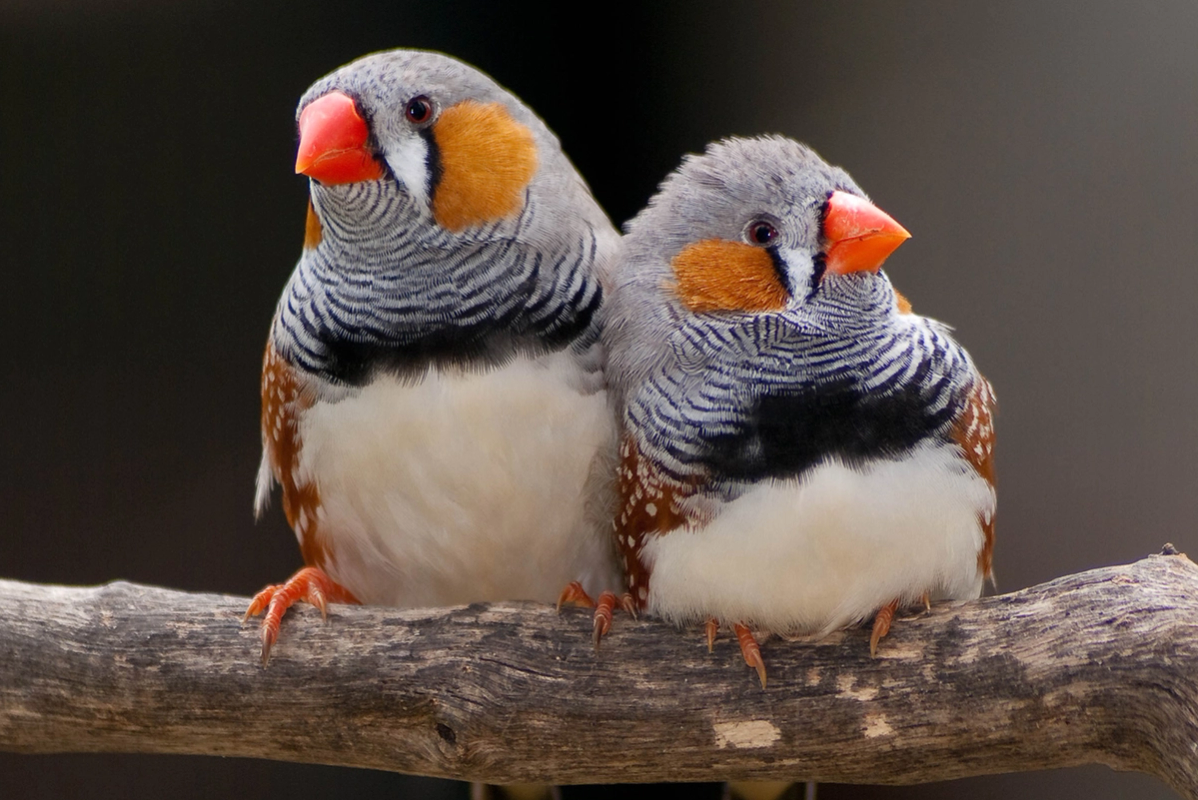
The Zebra Finch is one of Australia's most familiar and beloved small birds. Found across most of the continent, it is a lively, social and wonderfully patterned little finch that is equally at home in the outback, on farmland, or in suburban areas near water. Males are particularly eye-catching, with orange cheek patches, spotted chestnut flanks, fine black and white striping on the chest and throat, and a vivid red-orange bill.
The Zebra Finch is also one of the most studied birds in the world. Its ability to learn complex songs has made it a key subject in scientific research into how the brain processes and memorises sound, with discoveries from zebra finch studies contributing to our understanding of human speech and language.
Guests visiting the Australian Reptile Park on the Central Coast can see these lively little birds up close. Sociable, active and full of personality, the Zebra Finch is a firm favourite with visitors of all ages.
Quick Facts
- Scientific name: Taeniopygia guttata
- Family: Estrildidae (waxbills, munias and allies)
- Where they live: Throughout most of mainland Australia; also found in parts of Indonesia
- Size: Around 10 to 11cm long
- Weight: Around 10 to 16g
- Lifespan: Around 3 to 5 years in the wild; up to 7 years in captivity
Description
The Zebra Finch is a small, compact bird with a short, conical bill well suited to cracking open seeds. Males and females look quite different from one another, making them easy to tell apart.
Males are the more colourful of the two. They have a grey head and back, a white belly, and rich chestnut-brown flanks spotted with white. The throat and upper chest are crossed with fine black and white bars, which give the species its name. A bold orange patch sits on each cheek, and the bill is a bright red-orange. A thin red ring surrounds the eye.
Females are considerably plainer, with grey-brown upperparts, a paler belly and the same red-orange bill as males, but without the colourful cheek, flank or chest markings. Young birds resemble females until the males begin to develop their adult plumage.
Despite their small size, Zebra Finches are lively and conspicuous birds. They are almost always found in groups and are rarely quiet, keeping in constant contact with a cheerful, high-pitched chattering call.
Habitat
The Zebra Finch is the most widespread of Australia's native grassfinches, found across most of the mainland with the exception of some coastal and far northern areas, and absent from Tasmania. This wide distribution reflects how well adapted the species is to a variety of dry and open environments.
They favour dry open grasslands, scrublands, grassy woodlands, farmland, roadsides and areas near watercourses. One consistent requirement is access to water. Zebra Finches drink regularly and are almost always found within reach of a reliable water source, whether a river, dam, stock trough or garden birdbath.
They are highly tolerant of heat and dry conditions, which suits their preference for arid and semi-arid inland regions. After rainfall, when grass seed becomes abundant, flocks can grow significantly in size as breeding activity increases.
Outside Australia, a closely related subspecies is found in parts of Indonesia, particularly the Lesser Sunda Islands, where it inhabits similar open, dry habitats.
Diet
Zebra Finches are primarily seed eaters. Grass seeds make up the bulk of their diet and they spend a great deal of time foraging on or near the ground, picking up seeds from stems, seed heads and the soil beneath. They are nimble and efficient feeders, often moving through an area as a flock and covering a lot of ground quickly.
When breeding, they also take small insects to supplement their diet with protein. Insects are particularly important for feeding growing chicks in the early days after hatching, providing the nutrients needed for rapid development.
Their strong, conical bill is well designed for husking seeds of varying sizes. They are generalist seed eaters rather than specialists, which gives them the flexibility to take advantage of whatever is most available in their environment at any given time.
Reproduction
Zebra Finches are opportunistic breeders. Rather than following a strict seasonal pattern, they breed in response to rainfall and the abundance of grass seed that follows. In good years, a pair may raise several broods in succession.
Nests are dome-shaped structures built from dry grass, often lined with feathers, plant down and other soft materials. They nest in a wide range of locations including trees, shrubs, dense grass, termite mounds, fence posts and even buildings. Nests are sometimes built in loose colonies, with several pairs nesting close together.
Both parents share incubation of the three to six eggs, which hatch after around 12 to 14 days. The chicks develop quickly and fledge at around 21 days old, though they continue to be fed by their parents for a short time after leaving the nest. Young birds often remain with the family group before joining the wider flock.
The Zebra Finch is one of the most studied birds in the world. Scientists have used it extensively to understand how young birds learn complex songs from adults, and the findings have provided important insights into how the brain learns and remembers skilled movements, including those involved in human speech.
Zebra Finch FAQs
Is the Zebra Finch native to Australia?
Yes. The Zebra Finch is a native Australian bird and the most widespread of Australia's grassfinch species. It is found across most of the mainland and is a common sight in dry, open environments throughout the country.
Why is it called a Zebra Finch?
The Zebra Finch gets its name from the fine black and white barring on the throat and upper chest of the male, which resembles the striped pattern of a zebra.
What do Zebra Finches eat?
Zebra Finches eat mainly grass seeds, which they collect from stems and the ground. They also eat small insects, especially during the breeding season, to provide the protein needed for raising chicks.
How big is a Zebra Finch?
Zebra Finches are very small, growing to around 10 to 11cm in length and weighing between 10 and 16 grams.
Are Zebra Finches social birds?
Yes. Zebra Finches are highly social and are almost always found in flocks. They communicate constantly with one another using a variety of calls, and are rarely seen alone outside of the nesting period.
How do Zebra Finches breed?
Zebra Finches breed opportunistically in response to rainfall rather than following a fixed seasonal cycle. They build dome-shaped grass nests and both parents share incubation and chick-rearing duties. Chicks fledge at around 21 days old.
Why are Zebra Finches important to science?
The Zebra Finch is one of the most widely studied birds in the world. Scientists use them to understand how young animals learn complex skills from adults, particularly vocal learning. Research into zebra finch song has contributed significantly to our understanding of how the human brain learns and processes speech.
Can you see Zebra Finches at the Australian Reptile Park?
Yes! Guests can see Zebra Finches at the Australian Reptile Park in Somersby on the Central Coast of NSW. These active, sociable little birds are a delight to watch and a great introduction to Australia's native finch species.
Do Zebra Finches make good aviary birds?
Zebra Finches are among the most popular aviary birds in the world, second only to the budgerigar among Australian species. They are hardy, sociable and breed readily in captivity, which has made them a favourite with bird enthusiasts for generations.
Are Zebra Finches endangered?
The Zebra Finch is listed as Least Concern on the IUCN Red List. It is a common and widespread species that has adapted well to modified landscapes, including farmland and suburban areas, across most of Australia.