
First Funnel Web Egg Sac of the Season Arrives a Month Early
Spider keeper Emma Teni says four years of research has finally cracked the code on funnel web breeding.
Deep in the spider room at the Australian Reptile Park, something remarkable has appeared weeks before anyone expected it. A funnel web spider egg sac has arrived in July, a full month or more ahead of what keepers would normally see, and it could hold up to 200 future life-savers inside.
The Australian Reptile Park has recorded the earliest ever funnel web spider egg sac of the season, marking a significant milestone in its world-first antivenom breeding program.
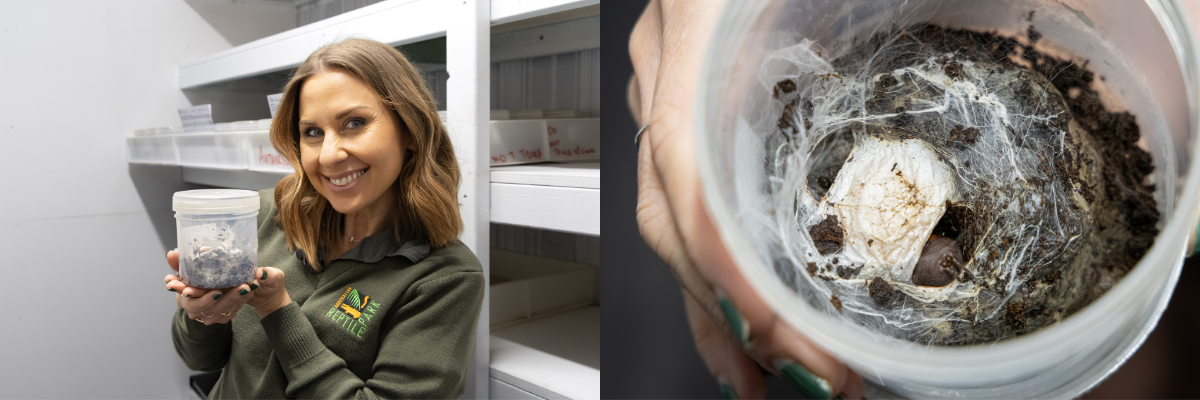
"Typically, we only start seeing these egg sacs around September, maybe August, but this year we've had a surprise egg sac as early as July. Having an egg sac this early in the season is so exciting. These egg sacs are the future of our antivenom program," said Emma Teni, Spider Keeper.
The breakthrough is the result of four years of careful, painstaking research into funnel web behaviour. The Park's breeding program is the first of its kind in the world, and getting these notoriously unpredictable spiders to reproduce on a reliable timeline has taken real dedication.
"The process to get to this point has taken us years. We've had to study the spiders, their behaviour, temperatures which they like to live at, even points of feeding, but we think we've cracked the code," said Emma.
The key insight came from rethinking the role of female funnel webs entirely. Funnel web antivenom is produced from venom milked exclusively from male spiders, which meant females were traditionally released back into the wild after capture. But close observation changed everything. By identifying gravid (pregnant) females and carefully recreating the ideal conditions for them to lay, the team found they could encourage egg sacs to drop earlier and more consistently.
Over the past four years, the Park has doubled its facility and tripled the number of spiders in the program. Each egg sac represents up to 200 spiderlings that will be raised at the Park for four to five years before maturing into males ready to enter the venom program. The goal is a self-sustaining pipeline that reduces reliance on public spider donations.
Venom collected at the Park is supplied to CSL Seqirus to produce the antivenoms that protect Australians across the country. For Emma, the work goes well beyond the science.
"Being a part of this programme makes me so incredibly proud. Not only can we give the spiders the best life possible, we are also able to save lives in the process. Being a mum, the value of life is so important to me and knowing that if someone's son or daughter was to be bitten by a funnel-web spider, the work that we do here could save their lives," said Emma.
If you find a funnel web spider, you can help too. Safely capture it and drop it off at the Australian Reptile Park or a participating collection point, and it will go straight into the life-saving program.